


Preparing for ERP Change in Agricultural Organisations
May 29, 2026 | The CORE Perspective
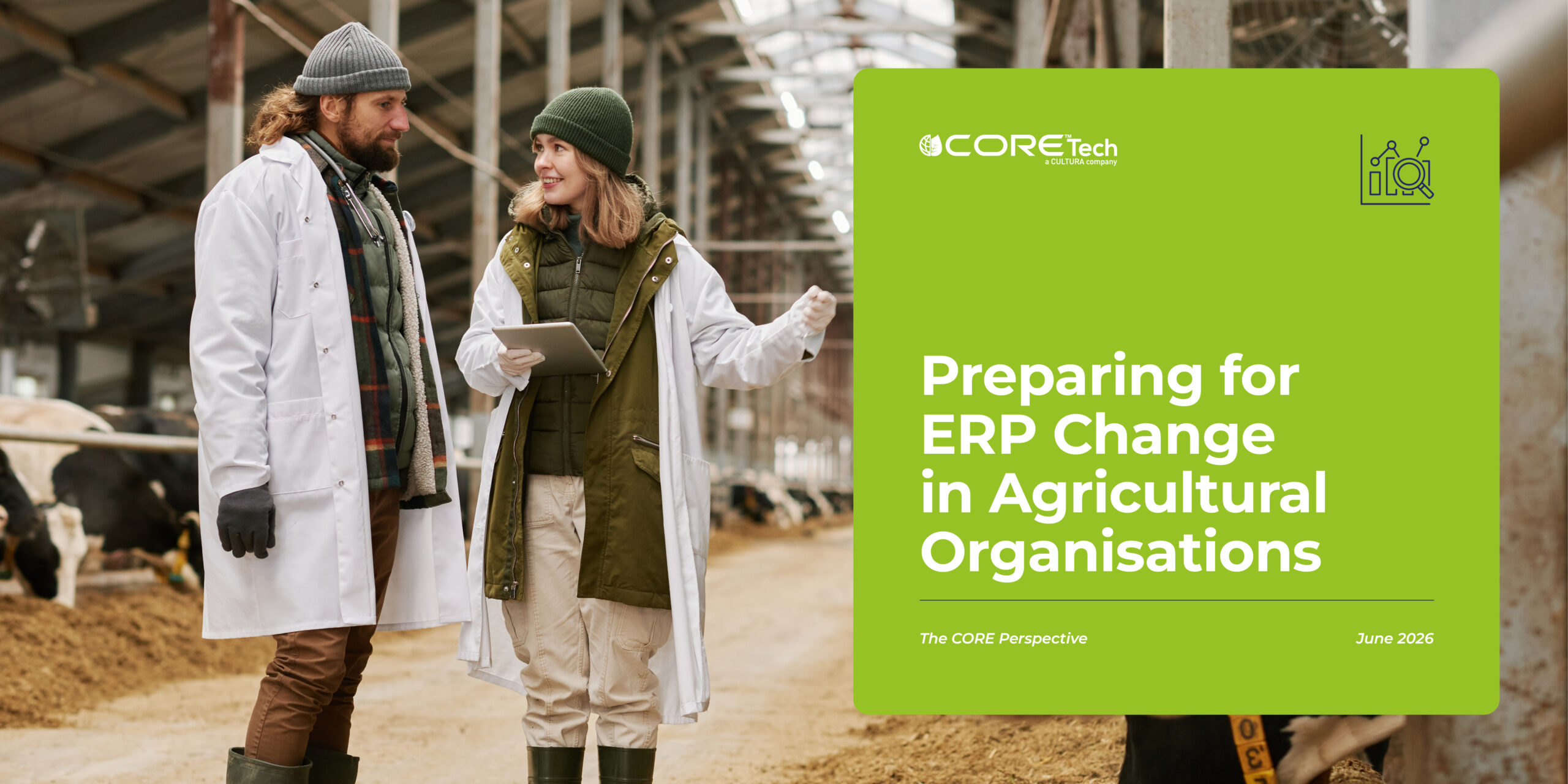
ERP change is rarely just a software project.
For agricultural organisations, it can affect finance, stock, procurement, supplier information, member communication, reporting, operational data and day-to-day decision-making. When it is approached in the right way, ERP change can improve visibility across the business, reduce avoidable manual work and give leadership teams more confidence in the information they use.
The process does require planning, but it does not need to feel overwhelming. With the right ERP partner, agricultural organisations can move through change in a structured, supported and manageable way.
The right ERP partner helps turn a complex change into a clear sequence of decisions, actions and milestones.
For dairy, grain, milling and agri-retail businesses, ERP change should be treated as a business change programme, not simply a system replacement. The organisations that benefit most are usually those that take time to understand their processes, involve the right people, prepare their data and define what success should look like before implementation begins.
A good ERP partner helps guide that journey. They bring structure, sector knowledge and proven implementation experience, helping the organisation move through each stage with clearer expectations and stronger internal confidence.
Why agricultural organisations reach the point of ERP change
ERP change often starts with familiar pressures.
A business may have outgrown its existing systems. Teams may be relying on spreadsheets to fill gaps between disconnected platforms. Reports may take too long to produce. Finance and operations may be working from different figures. Stock visibility may be inconsistent. Leaders may struggle to access reliable information when decisions need to be made quickly.
In agricultural organisations, these pressures are often intensified by complexity.
Dairy co-operatives, grain businesses, feed mills and agri-retailers may need to bring together information from areas such as milk management, grain intake, weighbridge activity, purchasing, stock, pricing, supplier records, customer orders, member data and financial reporting.
The trigger is rarely one isolated problem. More often, ERP change becomes necessary when the organisation recognises that its current systems, processes or reporting methods are limiting visibility, control or efficiency.
This is where a sector-focused ERP partner can add value early. Rather than expecting the organisation to define every requirement alone, the right partner can help clarify the business problem, identify where current processes are creating friction and recommend practical ways to move towards stronger visibility and control.
Start with the business problem
Before choosing or implementing ERP software, agricultural organisations need to be clear about the problem they are trying to solve.
This step is easy to rush. Teams can move too quickly into features, modules and technical requirements before fully understanding what needs to change. A new ERP system should not simply recreate existing inefficiencies in a more modern interface. It should support better ways of working.
Useful questions include:
- What information is difficult to access today?
- Where is manual work slowing the business down?
- Which reports are delayed, disputed or rebuilt outside the system?
- Where are errors most likely to occur?
- Which teams are working from different versions of the truth?
- What does leadership need to see more clearly?
These questions help define the direction of the project. They also give the ERP partner a clearer basis for recommending the right approach.
Core Tech’s role is not only to provide software. It is to work with agricultural organisations to understand their operating environment, identify where connected systems can improve visibility and guide the business towards practical, sector-appropriate ways of working.
The clearer the business problem, the stronger and more focused the ERP implementation is likely to be.
Map how work actually happens
A successful ERP project depends on understanding how work happens in practice, not just how it appears in formal process documents.
In many agricultural organisations, important knowledge sits with experienced people who understand the exceptions, seasonal pressures and workarounds that keep the business moving. A process may look simple on paper, but in reality it may involve several hidden steps.
A spreadsheet may exist because the current system cannot produce the right report. A manual check may be in place because data from one department is not trusted by another. A customer, supplier or member query may take longer than necessary because information is split across multiple systems.
Process mapping helps reveal this reality.
It does not mean the ERP system should be redesigned entirely around every existing process. In many cases, existing processes have developed around system limitations, manual workarounds or legacy ways of working. The value of business analysis is that it helps identify what should be preserved, what should be improved and where proven industry practice can support a better approach.
This distinction is important.
A good ERP implementation should not simply replicate old processes. It should help the organisation move towards clearer, more consistent and more efficient ways of working. Core Tech brings agricultural sector knowledge into this stage, helping businesses understand where their current processes align with good practice and where change may create long-term value.
For agricultural organisations, process mapping may include reviewing areas such as milk management, quality data, supplier payments, grain intake, weighbridge activity, stock, purchasing, dispatch, financial accounting, member portals and mobile applications.
The aim is not to document complexity for its own sake. The aim is to understand where the organisation needs clearer information, stronger connections between systems and better control over business data.
Involve the right people early
ERP change cannot be owned by one department alone.
Finance may lead the business case. IT may support technical decisions. Operations may understand the practical workflows. Senior leadership may define the strategic objectives. Customer-facing and field teams may know where communication or service issues arise.
Each group sees a different part of the business. If they are not involved early, important requirements can be missed.
This matters in agricultural organisations because ERP systems often sit at the centre of complex relationships. They affect internal teams, customers, suppliers, farmers, hauliers, auditors and management teams. A change in one process can have consequences elsewhere.
Early involvement also supports adoption. People are more likely to use a new system properly when they understand why it is being introduced and have had an opportunity to shape the outcome.
This is one of the areas where the right ERP partner can make change more manageable. Structured business analysis sessions, cross-functional engagement and clear communication help teams understand the purpose of the project and how their input contributes to a successful outcome.
Good preparation should clarify:
- Who owns the project internally?
- Who will make decisions?
- Who understands each critical process?
- Who will test the system?
- Who will train users?
- Who will communicate changes to wider teams?
ERP change works best when ownership is clear and the organisation treats implementation as a shared responsibility. With the right guidance, that shared responsibility becomes easier to manage.
Prepare data with the right guidance
Data quality is one of the biggest factors in ERP success, but data preparation does not need to be approached as an unsupported burden.
A new ERP system needs accurate, relevant and well-structured data to support clear reporting, stock visibility and financial control. The important point is knowing what data matters, what needs to be prepared and how it should be validated before and during migration.
This is where experienced ERP guidance is important.
A good implementation partner helps the organisation identify what data actually needs to migrate, which records should be reviewed, what can be cleansed or archived, and how migrated data should be checked. This reduces unnecessary complexity and helps teams focus on the data that will support the future system.
Agricultural organisations may need to review:
- Which data needs to be migrated?
- Which records are current and which are obsolete?
- Where duplicates exist?
- Who owns each data set?
- What data should be cleansed before migration?
- How will migrated data be checked?
- What historical information needs to remain accessible?
This may include customer records, supplier records, product files, stock data, contracts, pricing, member information, payment data and financial history.
Data preparation is an important stage, but with a structured approach it becomes manageable. Core Tech supports customers through this process by helping define priorities, advising on data readiness and guiding validation so that teams can move into the new system with greater confidence.
The objective is not perfection for its own sake. The objective is to give the organisation reliable information that supports reporting, decision-making and future improvement.
Think beyond go-live
Go-live is an important milestone, but ERP work does not end there.
The first days and weeks after launch are when teams begin working differently in real conditions. Questions arise. Processes are tested. Users discover what they understand well and where they need more support. Managers start to see how information flows through the system.
For this reason, ERP planning should include training, support and post-launch review from the beginning.
A strong implementation approach should cover project scoping, business analysis, data migration, training, go-live support and ongoing review. It should also allow the organisation to confirm that the solution reflects the agreed scope and delivers against the project objectives.
Where appropriate, a phased delivery model can also help organisations move through ERP change in defined stages, giving teams clearer milestones and reducing the pressure of trying to change everything at once.
This matters because agricultural organisations continue to change. Markets shift. Reporting requirements evolve. Customer and member expectations develop. Operational pressures change over time.
The right ERP partner helps customers move beyond launch with confidence. Training, support, phased delivery where appropriate and ongoing engagement all help reduce implementation risk and support adoption across the business.
ERP should support the organisation beyond implementation, not simply get it to launch day.
Avoid common ERP change risks
ERP projects are most likely to become difficult when expectations, ownership or communication are unclear.
One common risk is poor scoping. If the project does not clearly define what will be included, what will be phased and what success looks like, expectations can drift.
Another risk is unclear ownership. ERP affects the whole business, so decisions need to be made by people who understand both operational detail and strategic priorities.
Communication is also critical. Teams need to know why change is happening, how it affects them and what support will be available. Without this, uncertainty can grow and adoption can suffer.
Timelines also need to be realistic. Agricultural organisations have seasonal cycles, peak trading periods and operational deadlines. These should be considered when planning implementation.
These risks can be reduced with structure and experience. A sector-aware ERP partner can help define the project scope, support decision-making, guide stakeholder engagement and recommend a phased approach where this is the most practical route.
ERP change should be connected to the organisation’s commercial, operational and financial priorities. The software provides the platform, but the wider objective is stronger business control.
Where Core Tech fits
Core Tech works with agricultural organisations across dairy, grain, milling and agri-retail, supporting businesses that need ERP systems shaped by the realities of their sector.
Its role is to guide organisations through ERP change in a structured and practical way. That includes understanding current processes, recommending sector-informed best practices, supporting data preparation, helping teams engage with the project and providing training and support throughout the implementation journey.
Core Tech does not approach ERP as a blank-page customisation exercise. Its platforms are built around agricultural workflows and industry knowledge, with configuration and specific development considered where there is a clear business need. This helps customers benefit from proven sector practice while still ensuring the system reflects the requirements of their organisation.
- COREmilk supports dairy businesses by connecting milk management and financial reporting, giving teams clearer visibility across operational and financial activity.
- COREmill supports grain and milling businesses across areas such as grain intake, weighbridge activity, contracts, sales, relevant milling interfaces and financial reporting.
- COREretail supports agri-retail businesses by bringing purchasing, stock, pricing, sales and financial management together to improve visibility across the business.
Across these areas, the objective is not simply to replace software. It is to help agricultural organisations improve visibility, reduce avoidable manual work and build greater confidence in business information.
Preparing properly makes ERP change manageable
ERP change is a significant step, but it becomes far more manageable when the organisation is guided through it properly.
The starting point should always be the business problem, not the software feature list. Organisations should map how work happens today, involve the people who understand the details, prepare data with the right guidance, plan for training and support, and think beyond go-live.
A strong ERP partner helps make each stage clearer. They bring structure to the project, sector expertise to the analysis, practical guidance to data preparation, and support to the teams who will use the system every day.
Agricultural organisations operate in complex and changing conditions. Their systems need to support that complexity without adding unnecessary friction.
With the right partner, ERP change can help move the business towards clearer information, more connected processes and greater confidence in day-to-day decisions.
FAQs
How do we know if our agricultural organisation is ready for ERP change?
You may be ready for ERP change if teams rely heavily on spreadsheets, reports take too long to produce, data is entered more than once, or finance and operations are working from different information. Other signs include poor stock visibility, manual reconciliation, limited reporting confidence and systems that no longer support the scale or complexity of the business.
Why is process mapping important before ERP implementation?
Process mapping helps reveal how work actually happens across the organisation. It identifies manual steps, duplicated effort, system gaps and informal workarounds. It also helps the ERP partner recommend where existing processes should be improved, where industry best practice can be applied and where configuration may be required.
What data should be prepared before moving to a new ERP system?
Agricultural organisations should review customer records, supplier records, stock data, product files, pricing, contracts, member information, payment data and financial history. An experienced ERP partner can help identify what data needs to migrate, advise on cleansing and prioritisation, and guide testing and validation before the new system goes live.
What happens after ERP goes live?
After go-live, teams need support, training and time to settle into new ways of working. Questions will arise as users begin working in the system day to day. A strong post-launch support process helps maintain confidence and ensures the system continues to meet the agreed project objectives.
How can Core Tech support ERP change in agricultural organisations?
Core Tech supports agricultural organisations through business analysis, structured implementation, data migration guidance, training, go-live support and ongoing support. Its agriculture ERP products include COREmilk, COREmill and COREretail, supporting dairy, grain, milling and agri-retail businesses across Ireland and the UK.
Persona alignment: General Manager / CEO, Finance & Systems Controller, Co-op Operations Director.
Brand intent: Core Tech master brand first, with product references used to support the broader ERP-change message.
Key positioning shift: ERP change is presented as structured, guided and manageable with the right sector-focused ERP partner.

Contact Us
Speaking with a member of our team can best determine how we can assist your company. Get in touch to find out more!
"*" indicates required fields


